
Iddat Period in Islam: How Long It Lasts After Divorce or Death
When a marriage ends, the question of what comes next often arrives quickly: from relatives, from the woman herself, and sometimes from families already asking about a new rishta. In Islam the first answer is the iddat period, a waiting time before a woman may remarry. Its length depends on how the marriage ended and on whether she is pregnant. This guide sets out each iddat period with its Quran reference, explains what iddat means in daily life, and notes how Pakistani law treats divorce timing.
What iddat is, and why it exists
Iddat (Arabic 'iddah) means "counting". It is a set period after divorce or a husband's death during which a woman does not marry anyone else. Scholars explain several purposes: it makes clear whether she is pregnant and so protects the child's lineage; after a revocable divorce it gives the couple time to reconcile; and after a death it allows a period of mourning with dignity.
Iddat is not a punishment, and it does not mean a woman is shut away from life. It is a pause with rights attached, including housing during the waiting period after divorce.

Iddat period after divorce
If she has monthly periods
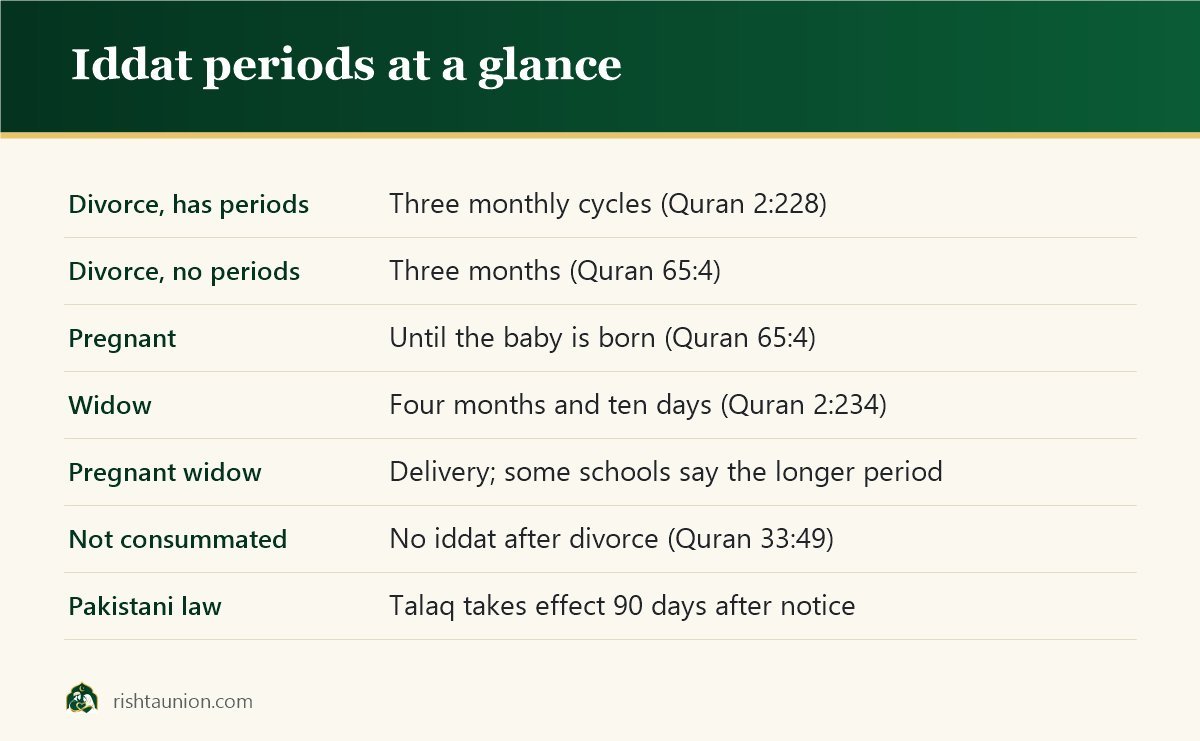
The Quran says: "Divorced women must wait three monthly cycles" (Surah Al-Baqarah 2:228, The Clear Quran translation). The Arabic word is quru'. Scholars differ on whether it means three menstrual periods or three intervals of purity between them, which can change the exact end date by some days. A scholar you trust can tell you which view your family follows.
The same verse says husbands have the right to take their wives back during this time if they want reconciliation. That is why, after a first or second revocable talaq, iddat is also a window for a couple to repair the marriage.
If she does not have periods
For a woman who no longer menstruates, or who has not yet begun to, the iddat is three months (Surah At-Talaq 65:4).
If she is pregnant
The iddat lasts until she gives birth, however long or short that is (Surah At-Talaq 65:4).
If the marriage was never consummated
If a couple divorce before the marriage was consummated, there is no iddat for the wife to observe (Surah Al-Ahzab 33:49). She may remarry without waiting.
Iddat period after the death of a husband
A widow's iddat is four months and ten days (Surah Al-Baqarah 2:234). The verse adds that once the period ends, she is free to decide for herself in a reasonable way.
A hadith in Sahih al-Bukhari (1280) records the Prophet ﷺ saying that a believing woman should not mourn anyone for more than three days, except her husband, for whom the mourning lasts four months and ten days. During this time many widows avoid adornment, perfume and bright clothing, and stay mainly in their marital home, going out for genuine needs. Practice in the details differs between families and schools, so ask a scholar about your own situation.
If the widow is pregnant
Here the schools differ. The majority of Sunni scholars hold that her iddat ends when she gives birth, based on Surah At-Talaq 65:4 and the report of Subay'a al-Aslamiyya, who was allowed to remarry after giving birth a short time after her husband's death (Sahih al-Bukhari 5320). Scholars of the Ja'fari (Shia) school, and some early Companions, held that she observes whichever is longer: four months and ten days, or until delivery. Families should follow the guidance of their own scholar.
Daily life during iddat
A few points help families handle this period kindly:
- Housing after divorce. The Quran tells husbands not to turn divorced wives out of their homes during iddat (65:1) and to house them as they themselves live, according to their means, without harassing them (65:6). If she is pregnant, he must support her until she gives birth (65:6).
- No new nikah. A woman cannot be married to anyone else until her iddat ends. Surah Al-Baqarah 2:235 allows a man only to hint at a proposal to a widow during her iddat, forbids secret promises, and says no marriage contract may be made until the waiting period ends.
- Mehr and other dues. Iddat does not cancel what she is owed. Any deferred mehr usually becomes due on divorce or death; our guide to haq mehr explains how.
- Support, not silence. Relatives can help most by sorting practical matters, such as documents, money and children's routines, rather than pushing early decisions.
Iddat and the law in Pakistan
Pakistani law sets its own timetable for divorce, separate from the religious count. Under section 7 of the Muslim Family Laws Ordinance 1961:
- A husband who pronounces talaq must give written notice to the chairman of the union council and send a copy to his wife.
- Unless revoked earlier, the talaq does not take effect until 90 days after the notice reaches the chairman.
- If the wife is pregnant when talaq is pronounced, it does not take effect until the 90 days or the pregnancy end, whichever is later.
- Within 30 days the chairman forms an arbitration council to try to bring about reconciliation.
Section 8 applies the same process, as far as it fits, to other forms of dissolution, such as khula. For the court route, see our guide to the khula procedure in Pakistan.
The 90 legal days and the religious iddat do not always end on the same date. Before a new nikah, it helps to be able to show that the earlier marriage has legally ended, so keep every notice and certificate from the union council. Our guide to marriage registration in Pakistan explains how registration works.
This is general information, not legal advice. Rules and procedures differ by province and change; confirm with the union council, NADRA, or a family lawyer.
Frequently asked questions
How long is the iddat period after divorce?
For a woman who has periods, three monthly cycles (2:228). For one who does not, three months (65:4). If she is pregnant, until she gives birth (65:4). If the marriage was not consummated, there is no iddat (33:49).
How long is iddat after the death of a husband?
Four months and ten days (2:234). If the widow is pregnant, most Sunni scholars say it ends at delivery, while the Ja'fari school says whichever period is longer.
Can a rishta be discussed during iddat?
A widow may receive only an indirect hint of a proposal, with no promises, and no nikah can take place until iddat ends (2:235). Most families wait until the period is over before any formal talk.
Does the 90-day legal period replace iddat?
No. The 90 days decide when a talaq takes legal effect in Pakistan. Iddat is a religious obligation with its own count. Ask both a scholar and a lawyer if the dates differ.
When the time does come to think about marrying again, Rishta Union has a dedicated space for a second marriage rishta, where profiles show who manages them and every member passes an ID and video check.
Keep reading
Khula Procedure in Pakistan: A Calm, Step-by-Step Guide
How the khula procedure in Pakistan works: legal aid, documents, the family court, reconciliation, mehr, the union council's 90 days and your certific...
Read article
Marriage in Islam: The Purpose of Nikah, Explained Simply
What marriage in Islam is for: tranquillity, mercy, a firm covenant and family, with Quran and hadith references and what this means for a rishta toda...
Read article
Dua for Marriage: Quranic Duas and Sunnah Guidance for a Good Spouse
A dua for marriage from the Quran, with Arabic, meaning and references, the best times to ask, and how to pair dua with patience and real effort.
Read article