
How to Verify a Rishta Proposal in Pakistan, Safely and Respectfully
A promising proposal creates a quiet tension. You want to trust the family, and you also want to be sure. Asking questions can feel rude; not asking can be costly. Verification done well resolves that tension. It is a short, fair process both families go through, not an investigation of one side by the other.
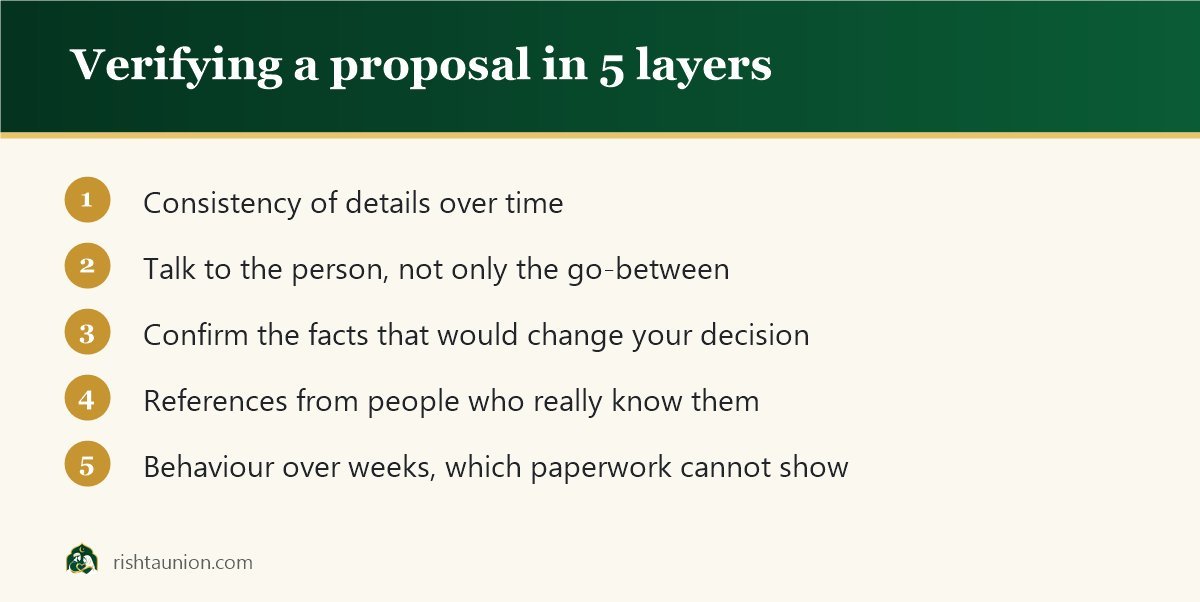
Layer 1: Consistency over time
The simplest check costs nothing. Over several conversations, notice whether the basics stay the same: full name, city, profession, education, marital status, family members and future plans. A changed detail is not proof of anything. People misremember dates or describe a job loosely. Ask about the difference calmly and see whether the explanation makes sense.
What deserves attention is a pattern: a job title that keeps shifting, a city that changes with each call, or vagueness whenever marital history comes up.

Layer 2: Speak to the person, not only the go-between
Many proposals arrive through a relative, a bureau or a family friend. That is a normal starting point, but the information is second-hand. Speak directly with the prospective spouse, with family present if that is your custom. You learn more from how someone answers than from what an intermediary says about them.
A video call helps confirm that the person matches their photos and that the conversation is real. It does not prove that every claim is true, so treat it as one step, not the last one.
Layer 3: Confirm the facts that would change your decision
Not every detail needs checking. Focus on the facts that would change your answer:
- Marital status: single, divorced or widowed, and whether any marriage is still in place.
- Work: whether the job exists in the form described, especially for proposals from abroad.
- Education: where a degree is central to the decision.
- Residence abroad: the person's actual status in that country, if relocation is part of the plan.
Ask for evidence openly and offer the same in return: "We are happy to share our son's degree and job letter; could you share the equivalent?" Reciprocity keeps the process respectful. For official documents, rely on official channels and qualified professionals rather than shortcuts.
What you must never do: impersonate someone, buy data from leaked databases, access accounts, or pressure an employer to reveal private records. Apart from being wrong, these actions can be crimes.
Layer 4: References through people who actually know them
References work best when they are specific and consented to. A senior colleague, a teacher, a neighbour of many years or a mutual family friend can describe how someone behaves day to day. Ask about character and conduct, not gossip: "How does he treat people who work for him?" tells you more than "Is the family wealthy?"
Avoid sending relatives to make enquiries in the neighbourhood behind the family's back. If it is discovered, it damages trust before the relationship has started.
Layer 5: Behaviour, the part paperwork cannot show
Certificates confirm facts. They cannot confirm temperament. Over the weeks of conversation, notice:
- Does the person accept a "no" or a "not yet" without sulking or pressure?
- Do they keep small promises, such as calling when they said they would?
- How do they speak about their parents, siblings and former colleagues?
- Do they ask about your plans, or only describe their own?
These observations often settle the question long before any document does.
Protect documents, theirs and yours
When documents are exchanged, keep them private. Do not forward a CNIC or passport copy into family WhatsApp groups. Share them only with the people who need to see them, and delete them once the decision is made. A family that hesitates to send ID documents to strangers is being careful, not secretive.
On Rishta Union, every member passes an ID card and video check before they can connect with anyone. The ID images are reviewed by our team and then deleted; other members never see them. That removes many fake accounts, so your own checks can focus on the facts that matter to your family.
When the checks raise a problem
If something does not add up, pause and ask directly. Many issues have honest explanations. If the answer is evasive, or the family pushes you to "decide quickly before others take the proposal", treat that pressure as information. Report suspicious profiles on the site so they can be reviewed, and read our safety tips before any meeting.
Proposals from abroad deserve extra care with relocation and visa claims. Our page for Pakistanis in the UK covers questions families there often ask.
Questions about verifying a proposal
Is it rude to ask for proof of a job or degree?
Not when it is done openly and both families do the same. Framing it as a routine step for both sides keeps it respectful.
Does a video call prove someone is genuine?
It helps confirm that the person resembles their photos and is willing to talk. It does not confirm employment, marital status or intentions on its own.
Can we hire someone to investigate the family?
Use only lawful, licensed services, and never methods that involve deception or accessing private records. Ask whether the information you want is really needed for the decision.
Verification should end with informed confidence, not suspicion. To begin with members who have already passed an ID and video check, create a free profile. The step-by-step search guide explains where verification fits in the wider process.
Keep reading

How to Choose a Matrimonial Website in Pakistan: A 12-Point Checklist
Before you sign up to any Pakistani matrimonial website, run through this 12-point checklist on verification, privacy, family features, costs and safe...
Read article
Online Rishta Scams in Pakistan: Red Flags and What to Do
Spot online rishta scams in Pakistan: the common stories, the red flags, and exactly what to do if you have already sent money or photos.
Read article
Iddat Period in Islam: How Long It Lasts After Divorce or Death
The iddat period explained with Quran references: durations after divorce, after a husband's death and in pregnancy, what it means in practice, and th...
Read article