
Mehr e Fatimi: What It Is and How to Calculate It Today
Many families in Pakistan choose mehr e Fatimi for a daughter's nikah because it connects the marriage to the household of the Prophet ﷺ. But when the nikah khawan asks for a rupee figure, the room often goes quiet. Is it a fixed amount? Why do two relatives quote different numbers? This guide explains where mehr e Fatimi comes from, why it is measured in silver, why scholars convert it differently, and how to work out the amount from today's silver rate yourself.
What is mehr e Fatimi?
Mehr e Fatimi (also written mahr Fatimi) is a mehr set at the amount traditionally linked to the marriage of Sayyida Fatimah, daughter of the Prophet ﷺ, to Ali ibn Abi Talib. Families choose it out of love and for the blessing of following that example, not because it is required. Islam does not oblige any family to use it; the general rules of haq mehr still apply, and a couple can agree a smaller or larger amount.
The name is used widely across Pakistani families. Many Shia families also refer to the same 500 dirham amount as mahr al-sunnah.
Where the figure comes from
The hadith give the basis in the old silver currency, the dirham:
- Sahih Muslim 1426: Aisha said the mehr the Prophet ﷺ gave his wives was twelve uqiyah and a nash, and explained that this came to five hundred dirhams.
- Sunan Abi Dawud 2106: Umar said the Prophet ﷺ did not give more than twelve uqiyah in marrying his wives or giving his daughters in marriage.
- Sunan an-Nasa'i 3375 and 3376: when Ali married Fatimah and had nothing else to give, the Prophet ﷺ asked him where his armour was and told him to give it to her.
One uqiyah is forty dirhams. Twelve and a half uqiyah is 500 dirhams; twelve uqiyah is 480. Reports about Fatimah's own mehr also differ, mentioning 480 dirhams, 500 dirhams or 400 mithqal of silver. These differences are why scholars do not all quote the same number.
Why it is measured in silver
A dirham was a silver coin. To use the amount today, scholars convert 500 dirhams into a weight of silver, and families then convert that weight into rupees at the current rate. Because silver prices move every day, mehr e Fatimi has no fixed rupee value. Anyone who gives you a single rupee figure as "the" mehr e Fatimi is quoting one day's rate, or an old one.
Why scholars give different conversions
Two questions decide the final weight: how many dirhams (500 or 480), and how much one dirham weighed. Classical sources describe the dirham differently, and modern scholars have worked from those descriptions to slightly different results. The views most often quoted in South Asia include:
| View | Dirhams | Approximate silver |
|---|---|---|
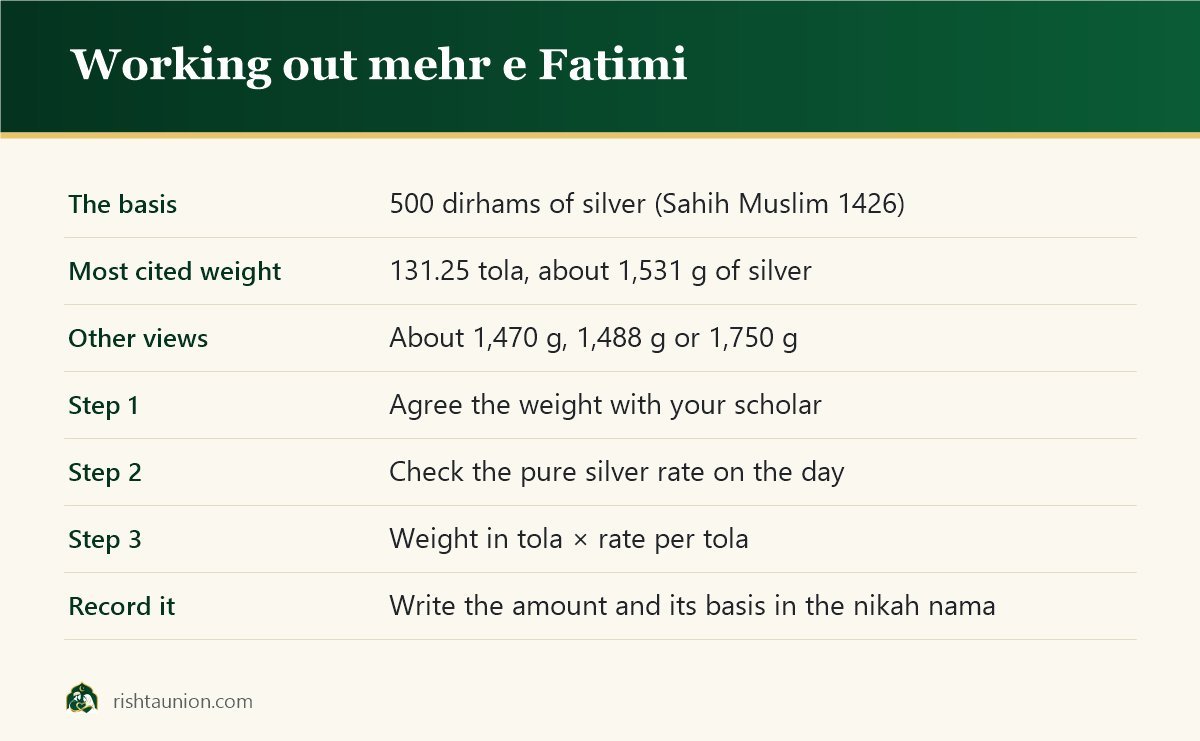
| Most widely cited | 500 | 131.25 tola, about 1,531 grams |
| Some scholars using 480 dirhams | 480 | about 1,470 grams |
| Lighter dirham weight | 500 | about 1,488 grams |
| A more cautious view based on mithqal | 400 mithqal | 150 tola, about 1,750 grams |
These figures come from published fatwa and fiqh summaries, and they are approximate. The point is not to pick the "right" row from an article. Ask the scholar or nikah khawan your family trusts which conversion they follow, and use that.
How to calculate mehr e Fatimi from today's silver rate
Once you know the weight, the sum is simple.
Step 1: Agree the weight
Settle with your scholar which conversion you are using, for example 131.25 tola or 1,530.9 grams of pure silver.
Step 2: Check the silver rate on the day
Look up the rate for pure (24 carat) silver from your local sarafa market or a reliable daily rate listing. In Pakistan the rate is often quoted per tola and sometimes per 10 grams. Note the date.
Step 3: Multiply
- If the rate is per tola: weight in tola × rate per tola.
- If the rate is per 10 grams: weight in grams ÷ 10 × rate per 10 grams.
A worked example (illustration only)
Suppose, purely to show the arithmetic, that silver were Rs 1,000 per tola. Then 131.25 tola × Rs 1,000 = Rs 131,250. This is not today's rate. Use the real rate on the day of your nikah, and you will get a very different figure.
One tola is about 11.66 grams, so if a rate is given per gram you can convert either way.
Paying in silver or in rupees
Families handle this in a few ways:
- Pay in silver itself. The groom gives the agreed weight of silver. The value then moves with the market and the bride holds the metal.
- Pay the rupee value on the day. The amount is calculated at the nikah and paid as money.
- Defer it. Part or all is deferred, to be paid later.
If any part is deferred, think about inflation. A rupee figure fixed in 2026 may be worth much less in twenty years, while a promise of a stated weight of silver keeps its link to the metal. Some families write both the silver weight and the rupee value at the time of the nikah, so the basis is clear later.
Recording it in the nikah nama
Whatever you decide, write it clearly in the dower columns of the nikah nama: the total, how much is prompt and how much deferred, and whether any part was paid at the nikah. Writing only "mehr e Fatimi" invites argument later about which conversion and which day's rate was meant. Our nikah nama format guide explains each column, and the guide to marriage registration in Pakistan covers what happens to the form after the nikah.
Frequently asked questions
How much is mehr e Fatimi in rupees today?
There is no fixed rupee amount. Take the silver weight your scholar follows and multiply it by the current silver rate on the day of the nikah.
Is mehr e Fatimi compulsory or better than other amounts?
It is not compulsory. Many families choose it for its connection to the Prophet's household, but any fair amount both sides agree on is valid.
Why do different people quote different weights?
Scholars differ on whether the original amount was 500 or 480 dirhams and on how much a dirham weighed, so the silver weight varies slightly between views.
Can mehr e Fatimi be given in gold instead of silver?
Families can agree to give its value in gold or money. Agree the silver-based value first, then write clearly in the nikah nama what is being given.
For any ruling specific to your family, ask a scholar you trust. When you are ready to look for a match who shares your values, create a free Rishta Union profile.
Keep reading

Baraat: What Happens on the Day and How to Plan It
What the baraat is, the order of the day from arrival to rukhsati, regional customs in Pakistan, and practical tips on guests, timing and the bride's...
Read article
Mehndi Ceremony: Customs, Timing and Simple Planning
A practical guide to the Pakistani mehndi ceremony: what happens, when, who hosts, regional customs, and how to plan guests, henna, timing and budget...
Read article
Marriage Registration in Pakistan: Registering Your Nikah at the Union Council
How marriage registration in Pakistan works: the law, the Nikah Registrar's duty, what happens at the union council, and fixing late or missing regist...
Read article