
Nikah Nama Format in Pakistan: Every Column Explained
Most couples sign their nikah nama in a few minutes, surrounded by relatives, with tea on its way and no one reading the small print. Yet this one sheet is the legal record of the marriage. It sets out the haq mehr, any conditions the couple agreed, and whether the wife holds a delegated right of divorce. The nikah nama format used in Pakistan is a standard form with 25 columns. Once you know what each column asks, you can agree the answers calmly at home instead of under pressure on the day.
Where the form comes from
The Muslim Family Laws Ordinance 1961 says every marriage solemnised under Muslim law must be registered (section 5). The union council licenses Nikah Registrars, and rules under the Ordinance prescribe the form. Provincial versions differ slightly, but the core 25 columns are the same.
Two points about filling it are worth knowing:
- In Punjab, a 2015 amendment requires the Nikah Registrar or the person solemnising the nikah to fill all columns accurately with the specific answers of the bride or groom, with a penalty for not doing so.
- In September 2026 the Supreme Court directed that no column should be left blank without a lawful basis, and that registrars must explain the entries, especially dower, special conditions and delegated talaq, before anyone signs. In 2025 the Court had also asked the federal and provincial governments to make the form simpler to understand.
Reading the nikah nama format column by column
Columns 1 to 6: place, bride and groom
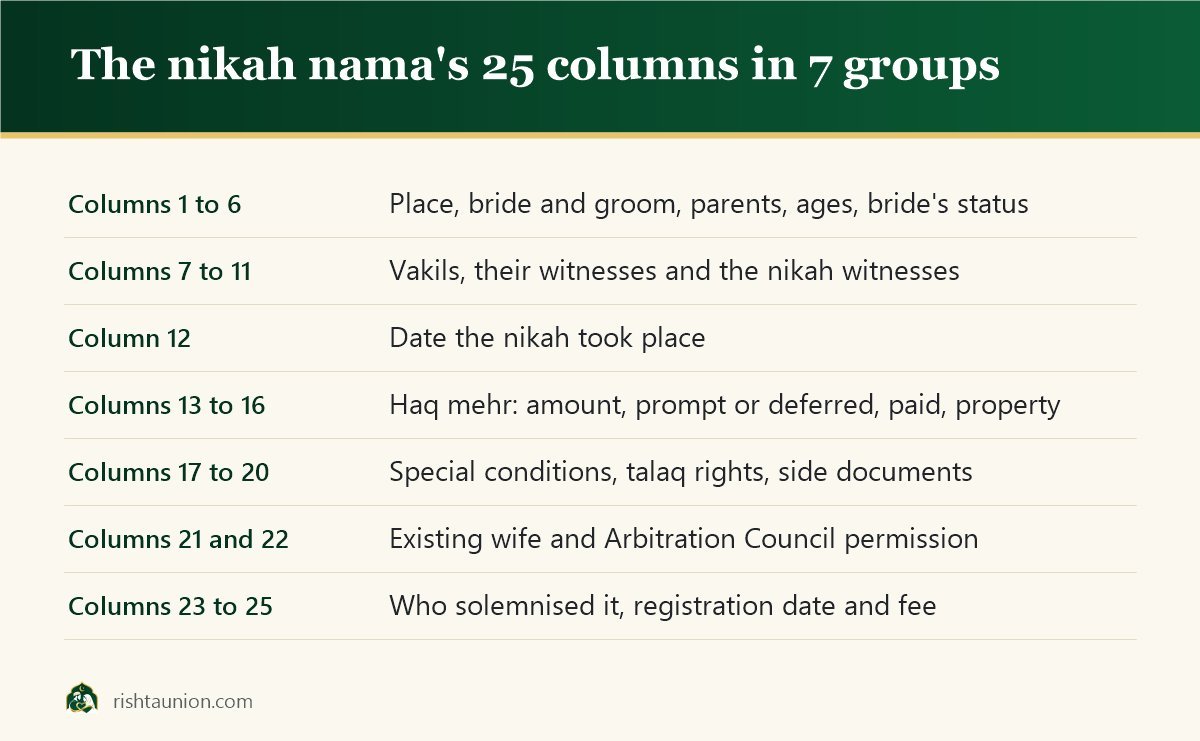
The first six columns record where the nikah took place (ward, union council, tehsil and district), the names of the groom and bride with their fathers' names and addresses, and their ages. Column 5 asks about the bride's marital status, for example whether she is unmarried, widowed or divorced.
Check spellings against each person's CNIC. A small difference here can cause problems later, when the marriage is entered in official records.
Columns 7 to 11: vakils and witnesses
These columns name the vakil (representative) of the bride and of the groom, if any, the witnesses to the appointment of those vakils, and the witnesses to the nikah itself, with fathers' names and addresses. Make sure each witness actually attended and knows what they are signing.
Column 12: date of the nikah
The date the marriage was contracted: the day of the nikah, not of the rukhsati.
Columns 13 to 16: haq mehr
This is the heart of the financial agreement.
- Column 13: the total amount of mehr, whether in money, gold or property.
- Column 14: how much is prompt (muajjal, payable on demand) and how much is deferred (ghair muajjal).
- Column 15: whether any part was paid at the time of the nikah, and how much.
- Column 16: if property is given as mehr, its details and the value agreed.
Under section 10 of the Ordinance, if the nikah nama does not specify how the mehr is to be paid, the entire amount is presumed payable on demand. Property given as mehr should be described clearly enough to identify it. Vague entries such as "as per custom" invite disputes.
Column 17: special conditions
Couples can record conditions both sides agree to. Families sometimes use this column for matters such as the wife continuing her education or job, where the couple will live, or a monthly allowance. The entry should reflect what the two of you actually agreed, in your words, not a phrase the registrar adds on his own. These conversations go better long before the wedding; our guide to questions before an arranged marriage covers how to raise them.
Columns 18 and 19: talaq rights
Column 18 asks whether the husband has delegated the right of divorce (talaq-e-tafweez) to the wife, and on what conditions. Under section 8 of the Ordinance, a wife exercising a delegated right follows the same notice procedure as talaq under section 7. Column 19 asks whether the husband's own right of divorce has been restricted in any way.
Many registrars strike these columns out by habit. Whether to fill them is a choice for the couple and their families, and it is worth discussing openly. Parents of daughters often find this conversation hardest; our daughter's rishta guide explains why her own view must lead.
Column 20: documents about mehr and maintenance
If any separate document was drawn up at the time of the nikah about mehr, maintenance or similar matters, its existence and contents are noted here.
Columns 21 and 22: an existing wife
Column 21 asks whether the groom already has a wife and, if so, whether he has the permission of the Arbitration Council under the Ordinance to marry again. Column 22 records the details of that permission. Section 6 says no man may contract another marriage during an existing one without the Council's prior written permission, and such a marriage cannot be registered without it. Families considering a second marriage rishta should make sure this column is answered truthfully.
Columns 23 to 25: solemnisation and registration
The name of the person who solemnised the nikah, the date of registration, and the registration fee paid. Signatures and thumb impressions of the bride, groom, vakils, witnesses and registrar follow.
The nikah nama in Urdu, and your copies
The form is usually printed in Urdu, and some versions also carry English headings. Punjab's updated form, issued in 2022, adds a declaration of belief in the finality of prophethood that the bride and groom sign. The registrar keeps the record, gives copies to the bride and groom, and sends a copy to the union council, where the marriage is registered.
Pakistan's Ministry of Law said in June 2025 that no official Urdu version of the nikah nama has been issued, so the Urdu forms registrars use are local printings. The Urdu reference copy above lets you read every column in advance; it is for preparation, not for registration.
A short checklist before the nikah
- Ask the registrar for a blank form a week in advance and read it together.
- Agree the mehr amount, the prompt and deferred split, and any conditions.
- Decide together about columns 18 and 19, rather than leaving it to the registrar.
- Check every name and CNIC detail against the original cards.
- Before signing, read the completed form, or have it read aloud.
- Make sure you each leave with your own copy.
If you are still at the search stage, these topics are easier to raise early. On Rishta Union, real names and phone numbers stay private until a connect request is accepted, which gives families room to discuss practical matters at their own pace. You can create a free profile whenever you are ready.
This is general information, not legal advice. Rules differ by province and change; confirm with your union council, NADRA or a family lawyer.
Frequently asked questions
How many columns does the nikah nama have?
The standard form has 25 columns, followed by signatures. Some provincial versions add a declaration, such as Punjab's finality of prophethood declaration.
What happens if the mehr payment terms are left blank?
Under section 10 of the Muslim Family Laws Ordinance, if the mode of payment is not specified, the whole mehr is presumed payable on demand.
Does filling column 18 mean the wife can divorce at any time?
She can exercise the right on the terms written in that column, through the notice procedure the Ordinance sets out. The exact effect depends on the wording, so ask a family lawyer if you are unsure.
Can we get another copy of our nikah nama later?
Yes. Section 5 allows any person to inspect the record at the union council office, or obtain a copy, on payment of the prescribed fee, if any.
Keep reading
Jahez List and Dowry in Pakistan: What Faith and Law Actually Say
Why a written jahez list protects the bride, what Islam says about dowry, and what the 1976 dowry law and Punjab and KP marriage function laws say in...
Read article
Mehr e Fatimi: What It Is and How to Calculate It Today
Mehr e Fatimi explained: where the 500 dirham figure comes from, why scholars convert it to silver differently, and how to work it out from today's ra...
Read article
Baraat: What Happens on the Day and How to Plan It
What the baraat is, the order of the day from arrival to rukhsati, regional customs in Pakistan, and practical tips on guests, timing and the bride's...
Read article