
Jahez List and Dowry in Pakistan: What Faith and Law Actually Say
Few wedding topics cause as much quiet worry in Pakistani homes as jahez. Parents save for years, the bride's family wonders what is "expected", and some proposals end over it. Yet the most useful thing a family can do is rarely discussed: write a proper jahez list. This guide explains what dowry is, what Islam says about it, what the law in Pakistan says as of November 2026, and how to make a jahez list that protects the bride.
What jahez is, and what it is not
Jahez (also called daaj in Punjabi) is the household goods, clothes, jewellery and money a bride's parents give her at marriage. Over time, in many families, it has grown from a gift into an expectation, sometimes even a list of demands from the groom's side.
It helps to separate three different things that often get mixed up:
- Jahez (dowry): given to the bride by her own parents.
- Bari and bridal gifts: given to the bride by the groom and his family.
- Haq mehr: a religious obligation from the husband to the wife, recorded in the nikah nama. Mehr is not jahez and cannot be offset against it. See our guide to haq mehr.
What Islam says about jahez
Islam places the cost of setting up the home on the husband. The Quran tells husbands to house their wives as they themselves live, according to their means (Surah At-Talaq 65:6), and to spend according to what they have (65:7). Nothing in the Quran requires a bride's family to furnish the home.
A hadith in Sunan an-Nasa'i (3384) records that the Prophet ﷺ prepared for Fatimah a velvet garment, a water skin and a pillow stuffed with idhkhir grass. Scholars read this report in different ways, but it describes a few simple items, not a houseful of furniture. Across schools of thought, scholars agree that demanding jahez, or pressuring a bride's family into debt, is wrong. Parents giving their daughter something freely, out of love and within their means, is a different matter.
What the law in Pakistan says
The federal Dowry and Bridal Gifts (Restriction) Act 1976
This is still the main national dowry law. Its key provisions:
- Limits: the total value of dowry and presents given to the bride by her parents may not exceed Rs 5,000, and the same limit applies to bridal gifts (section 3).
- Presents from others: no present to either spouse may exceed Rs 100, with some exceptions (section 4).
- Ownership: all dowry, bridal gifts and presents given to the bride vest absolutely in her (section 5).
- Wedding spending: total marriage spending, including mehndi, baraat and walima, may not exceed Rs 2,500 (section 6).
- Lists: each side's parents must give the nikah registrar a list of dowry, bridal gifts and presents, with values, signed and attested by two witnesses (section 8).
- Penalty: up to six months' imprisonment, a fine of up to Rs 10,000, or both (section 9).
These money limits have never been updated and are widely ignored, and commentators agree the Act is rarely enforced. In August 2025 the National Commission on the Status of Women held a national consultation on reforming it, but we could find no amended law in force as of November 2026.
Provincial marriage function laws
- Punjab: the Punjab Marriage Functions Act 2016 bans the display of dowry to the public, along with limits such as the one-dish rule at public venues.
- Khyber Pakhtunkhwa: a 2018 marriage functions law regulates wedding spending and bridal gifts, but the provisions on dowry were removed before it passed, according to Dawn.
- Sindh: a 2017 bill to restrict dowry was debated but not passed.
Laws in this area change and are applied unevenly, so check the current position with a family lawyer in your province.
The part of the law that protects the bride
The most useful protection is section 5: whatever her parents give as jahez belongs to the bride, not to her husband or in-laws. Family courts in Pakistan hear claims for the return of dowry articles and a wife's personal property. A clear, signed jahez list is often the best evidence she will have.
How to make a jahez list
A jahez list is not a showpiece. It is a record. Families who keep a good one tend to have fewer disputes later.
What to include
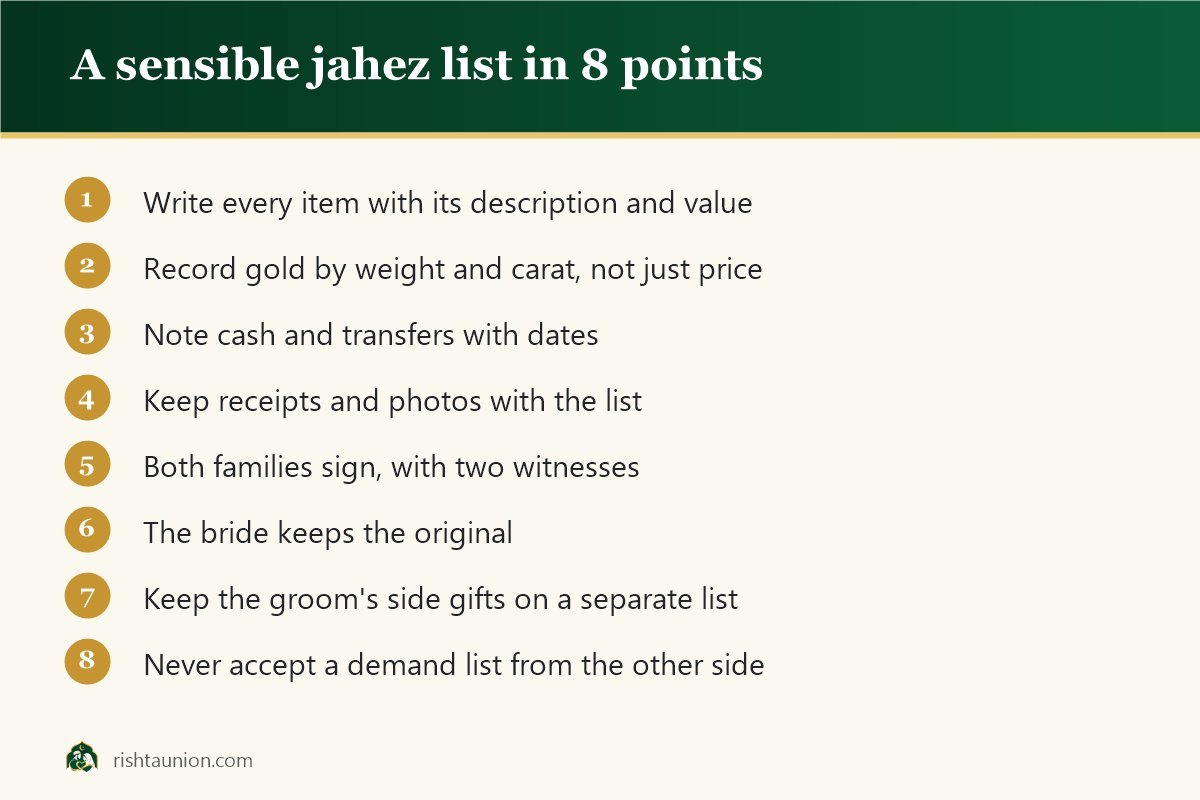
- Each item: name, brand or description, quantity, and value or price paid.
- Gold and jewellery: weight and carat, not only the price, since prices move.
- Cash or bank transfers: amount, date and to whom.
- Receipts and photos: kept with the list.
How to sign it
- Prepare two copies. Both families sign or thumb-mark, with two witnesses.
- The bride keeps the original; her parents keep a copy.
- Keep gifts from the groom's side (bari) on a separate list.
What to avoid
- Lists that describe items vaguely ("complete furniture set") with no values.
- Handing over documents or gold to in-laws "for safekeeping" without a written note.
- Accepting a demand list from the other side. That is the moment to pause the rishta, not to start borrowing.
Talk about expectations early, before anyone is emotionally invested. Our questions to ask before an arranged marriage include money and household questions, and the nikah nama format guide shows where to write any special conditions.
Many families are simplifying
Customs differ between Punjabi, Sindhi, Pashtun, Kashmiri and Karachi's Urdu-speaking families, and so do the items traditionally included. What is changing in all of them is that more families are choosing a smaller jahez, a gift of savings or gold in the bride's own name, or nothing beyond what the couple genuinely need. None of these choices needs justifying to anyone.
Frequently asked questions
Is jahez allowed in Islam?
Parents may give their daughter gifts freely and within their means. Demanding jahez, or making the marriage depend on it, is wrong according to scholars across schools.
Is dowry illegal in Pakistan?
Dowry is not banned outright. The 1976 Act limits it and requires lists, Punjab bans public display, and enforcement is weak. Check the current law in your province.
Who owns the jahez after marriage?
The bride. Under section 5 of the 1976 Act, dowry and gifts given to her vest absolutely in her, and family courts hear claims for their return.
What should a jahez list include?
Every item with its description and value, gold by weight and carat, cash with dates, receipts, and signatures of both families with two witnesses.
This is general information, not legal advice. Rules differ by province and change; confirm with the union council, nikah registrar, or a family lawyer.
A family that asks for jahez is telling you something important. If you are looking for a match that values character over contents, create a free Rishta Union profile, and use our guide to evaluating a rishta proposal to weigh what matters.
Keep reading
Mehr e Fatimi: What It Is and How to Calculate It Today
Mehr e Fatimi explained: where the 500 dirham figure comes from, why scholars convert it to silver differently, and how to work it out from today's ra...
Read article
Baraat: What Happens on the Day and How to Plan It
What the baraat is, the order of the day from arrival to rukhsati, regional customs in Pakistan, and practical tips on guests, timing and the bride's...
Read article
Mehndi Ceremony: Customs, Timing and Simple Planning
A practical guide to the Pakistani mehndi ceremony: what happens, when, who hosts, regional customs, and how to plan guests, henna, timing and budget...
Read article